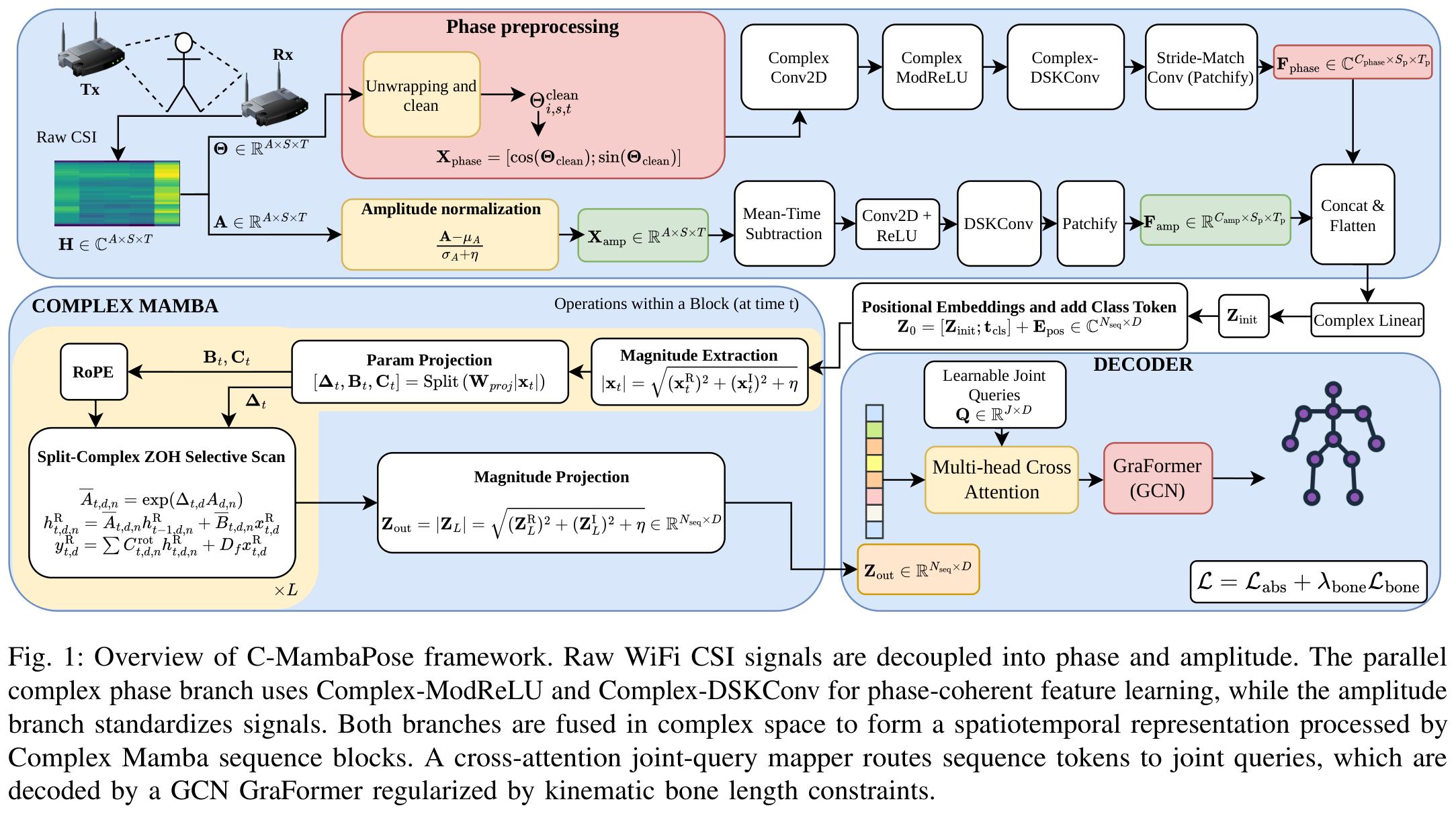
Cross-environment WiFi-based human pose estimation (HPE) suffers from severe domain shift caused by environmental multipath variations. We introduce C-MambaPose, a physics-informed complex Mamba framework that processes complex-valued Channel State Information (CSI) by decoupling phase and amplitude dynamics with complex state space models to achieve robust cross-environment 3D pose estimation.
@misc{nguyen2026cmambapose,title={C-MambaPose: A Physics-Informed Complex Mamba Framework for Cross-Environment WiFi Human Pose Estimation},author={Nguyen, Phuc H.},year={2026},note={Arxiv preprint}}
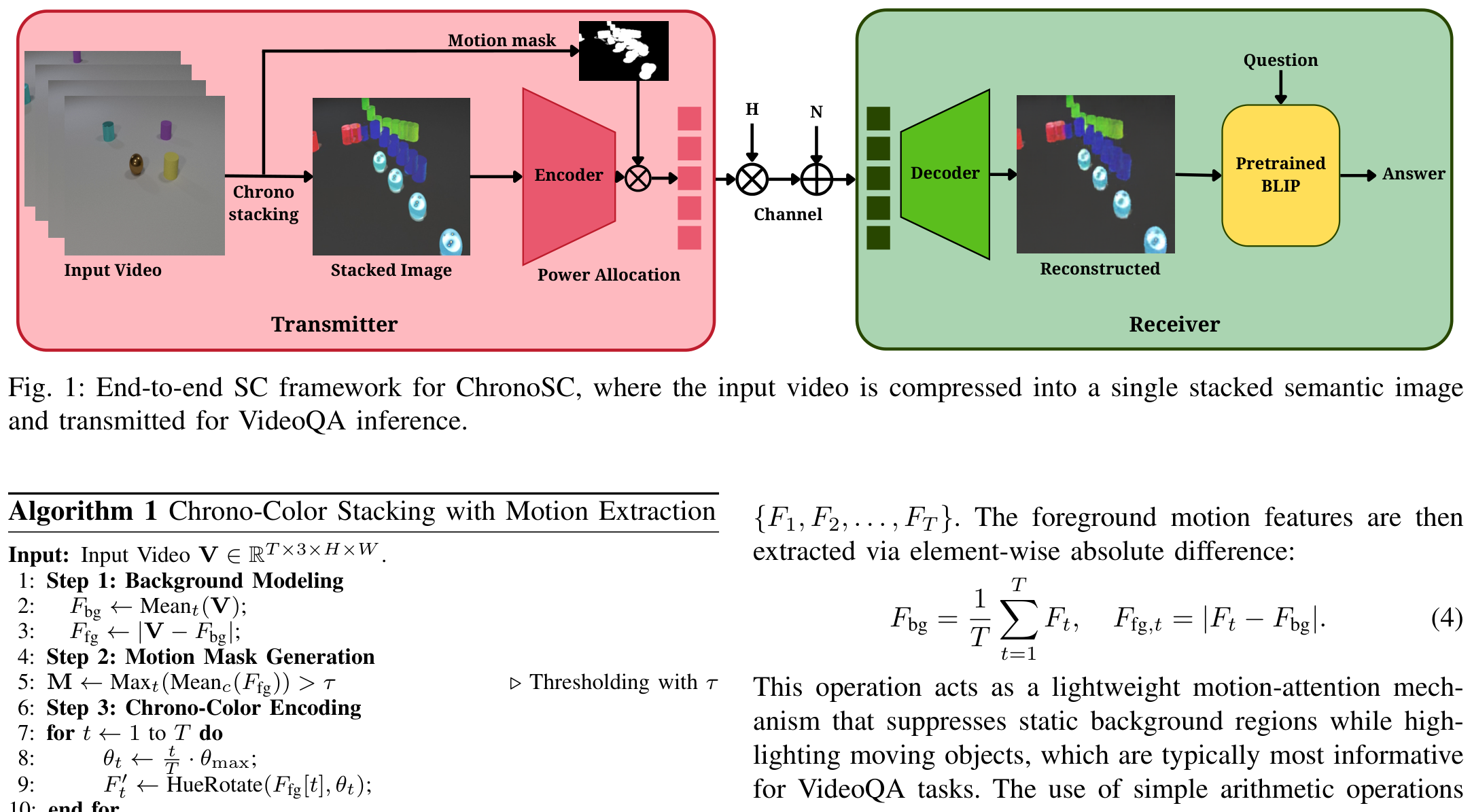
Task-oriented semantic communication (SC) is a promising paradigm to address bandwidth constraints and latency bottlenecks in video-based tasks such as Video Question Answering (VideoQA). We propose ChronoSC, a lightweight framework utilizing Chrono-Color Stacking to collapse video temporal dynamics into a single static image for efficient DeepJSCC transmission and direct consumption by pre-trained vision-language models.
@inproceedings{nguyen2026chronosc,title={ChronoSC: Task-Oriented Semantic Communication via Temporal-to-Color Encoding},author={Nguyen, P. H. and Nguyen, T. T. and Duong, Q. N. and Nguyen, Van-Dinh},booktitle={2026 IEEE 11th International Conference on Communications and Electronics (ICCE)},year={2026},month=may,note={Accepted}}
Major Revision
FISHER: Gradient-Decoupled Hierarchical Multi-Task Learning for Fine-Grained Aquatic Species Recognition
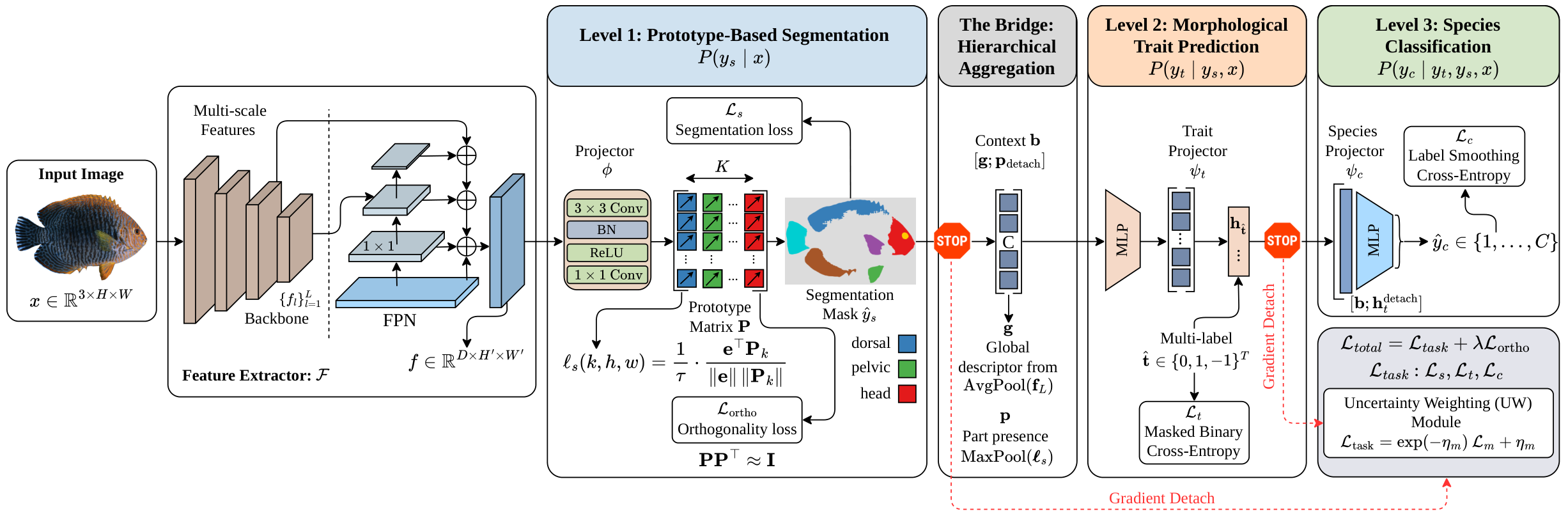
Fine-grained aquatic species recognition is inherently challenging due to extreme phenotypic similarities among related species and severe class imbalance in real-world distributions. In this paper, we propose FISHER, a gradient-decoupled hierarchical multi-task learning framework coordinating segmentation, morphological trait identification, and fine-grained classification. By decoupling conflicting task gradients and aligning trait prototypes, FISHER achieves state-of-the-art accuracy and significant gains on ultra-rare species.
@misc{nguyen2026fisher,title={FISHER: Gradient-Decoupled Hierarchical Multi-Task Learning for Fine-Grained Aquatic Species Recognition},author={Nguyen, H.-P. and Ngo, B. H. and Tran, M. P. and Nguyen, Van-Dinh},year={2026},month=jul,note={Major Revision},}
Smart aquaculture is transitioning from passive environmental monitoring to autonomous, closed-loop decision-making. This survey comprehensively investigates state-of-the-art sensing modalities, multi-modal sensor fusion, edge intelligence, and reinforcement learning-driven autonomous actuation in modern aquaculture facilities.
@article{dam2026survey,title={From Monitoring to Action: A Comprehensive Survey of Autonomous Decision-Making in Smart Aquaculture Systems},author={Dam, Q.-H. N. and Nguyen, P. H. and others},journal={Computers and Electronics in Agriculture},year={2026},note={Major Revision},}
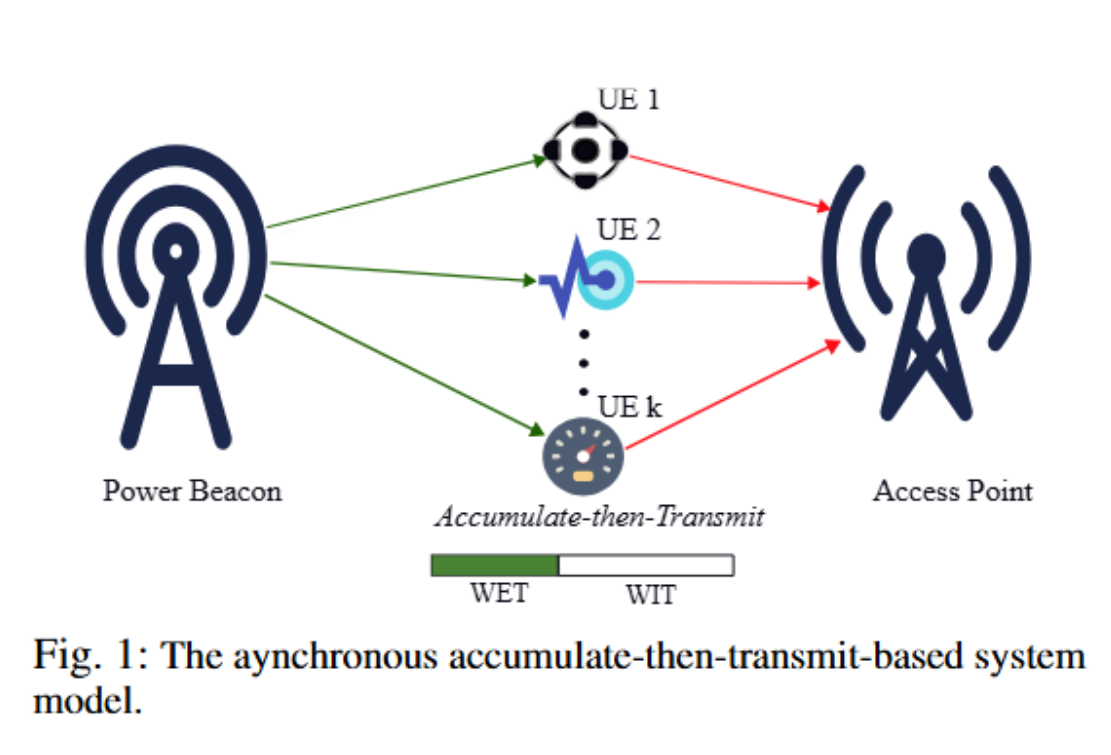
Low harvested energy poses a significant challenge to sustaining continuous communication in energy harvesting (EH)-powered wireless sensor networks. In this paper, we introduce a novel energy-aware resource allocation problem aimed at enabling the asynchronous accumulate-then-transmit protocol. We jointly optimize power allocation and time fraction dedicated to EH to maximize average long-term system throughput, accounting for both data and energy queue lengths.
@article{ngo2025energyaware,title={Energy-Aware Resource Allocation for Energy Harvesting Powered Wireless Sensor Nodes},author={Ngo, N. M. and Nguyen, T. T. and Nguyen, H.-P. and Nguyen, Van-Dinh},journal={IEEE Communications Letters},volume={29},number={3},pages={542--546},year={2025},month=mar,doi={10.1109/LCOMM.2024.3369687},}