Privacy-Preserving Thermal Fall Detection on Edge AI
Research internship at HKU AIoT Lab (The University of Hong Kong). Real-time edge hardening on NVIDIA Jetson Orin (6.7 → 20.8 FPS, latency < 0.3s), 91,800-frame multimodal dataset, and 10× false-positive rate reduction (40.7% to 1.5%) via passive infrared array sensing.
A research project conducted during my research internship at the HKU AIoT Lab (The University of Hong Kong), focusing on deploying, optimizing, and hardening TaFall — a balance-informed fall detection system powered by a low-cost, ultra-low-resolution passive infrared (thermal) sensor — for autonomous real-time operation on resource-constrained edge hardware.
While the core TaFall theoretical framework was published by the laboratory (Li, Zhang, Zhu, Jiang & Wu, arXiv:2604.09693), my internship tackled the critical engineering and algorithmic gap between an academic proof-of-concept and a trustworthy edge-deployed production system: rebuilding the real-time inference loop on NVIDIA Jetson Orin, collecting and auto-annotating a 91,800-frame multimodal thermal dataset, and isolating a preprocessing bug to achieve a 10× reduction in empty-room false alarms.
Live System Demonstration
Below is a live screen capture demonstrating the end-to-end edge pipeline running on the NVIDIA Jetson Orin. The top panel displays the real-time multi-modal evaluation stream (synchronized Intel RealSense RGB vs. Meridian 80×62 thermal array), while the bottom panel showcases the deployed browser dashboard streaming at 20.8 FPS with independent real-time confidence scores for human presence detection and balance-loss classification:
Demonstration: Real-time multi-person tracking and fall detection on NVIDIA Jetson Orin (Meridian MI48 thermal array, 20.8 FPS live streaming).
1. The Challenge: Private Fall Monitoring & The 2% FPR Trap
Falls represent the leading cause of fatal and non-fatal injuries among older adults:
- Epidemiology: Between 28% and 35% of individuals over age 65 fall at least once each year, accounting for 10–15% of all emergency department admissions.
- The Psychological Toll: Between 15% and 55% of older adults subsequently restrict their daily activities out of fear of falling, initiating a cycle of physical decline.
- The Privacy Dilemma: The majority of severe falls occur in bedrooms and bathrooms — exactly the private living spaces where optical RGB cameras are completely unacceptable and legally impermissible.
| Sensing Modality | Fall Accuracy | Privacy Preservation | Operates in Darkness | User Compliance | Hardware Cost |
|---|---|---|---|---|---|
| Wearables (Pendant/Watch) | Moderate | High | Yes | Very Poor (forgotten/uncharged) | Low (~$50–$150) |
| Optical Cameras (RGB-D) | Very High | Unacceptable | No (fails in dark) | High (passive) | Medium (~$100–$300) |
| mmWave FMCW Radar | Moderate | High | Yes | High (passive) | High (~$200–$500) |
| Passive Infrared Array (MI48) | High (TaFall) | Guaranteed (80×62 px) | Yes (Total Darkness) | High (100% Passive) | Ultra-Low (~$18 BOM) |
The 2% False-Positive Rate Trap
In academic literature, a 98% specificity (a 2% False Positive Rate) is frequently hailed as state-of-the-art. However, when deployed in a real-world home or hospital room:
- A monitoring system evaluating 1-minute temporal windows runs 1,440 inferences per day.
- A 2% false-positive rate translates into ~29 false emergency alarms every single day.
- Within 48 hours, caregivers experience complete alarm fatigue and switch the device off entirely.
“A fall detection system that cries wolf 30 times a day in an empty room is worse than no system at all. My internship was dedicated to driving that false-positive number down to zero on empty rooms without sacrificing fall sensitivity.”
2. The Baseline: TaFall & Balance-Informed Pose Dynamics
Prior thermal fall systems relied on crude velocity thresholds, height drops, or bounding-box bounding aspect ratios, generating pervasive false alarms whenever an occupant bent down to tie shoes, sat rapidly on a couch, or dropped a blanket.
The HKU AIoT Lab established TaFall (arXiv:2604.09693), founded on the World Health Organization (WHO) definition: a fall is fundamentally a transient, unrecoverable loss of balance, not simply a vertical descent.
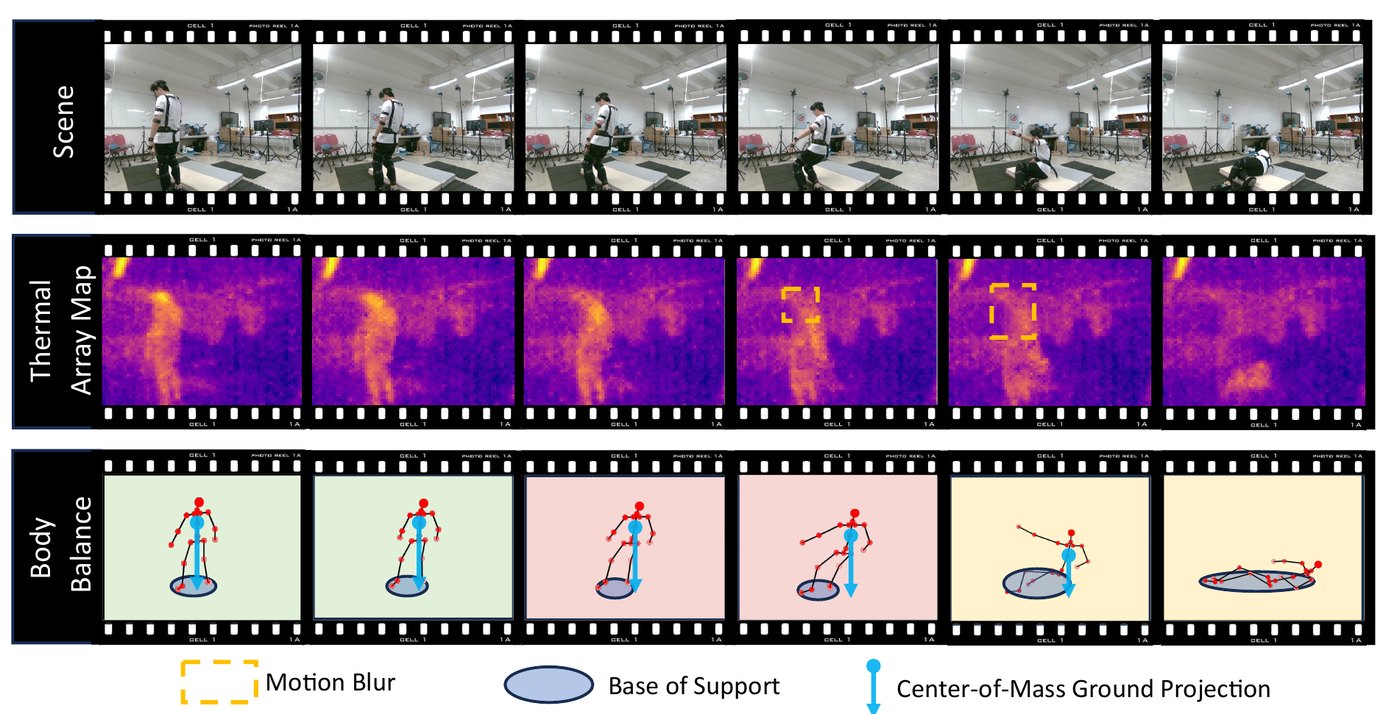
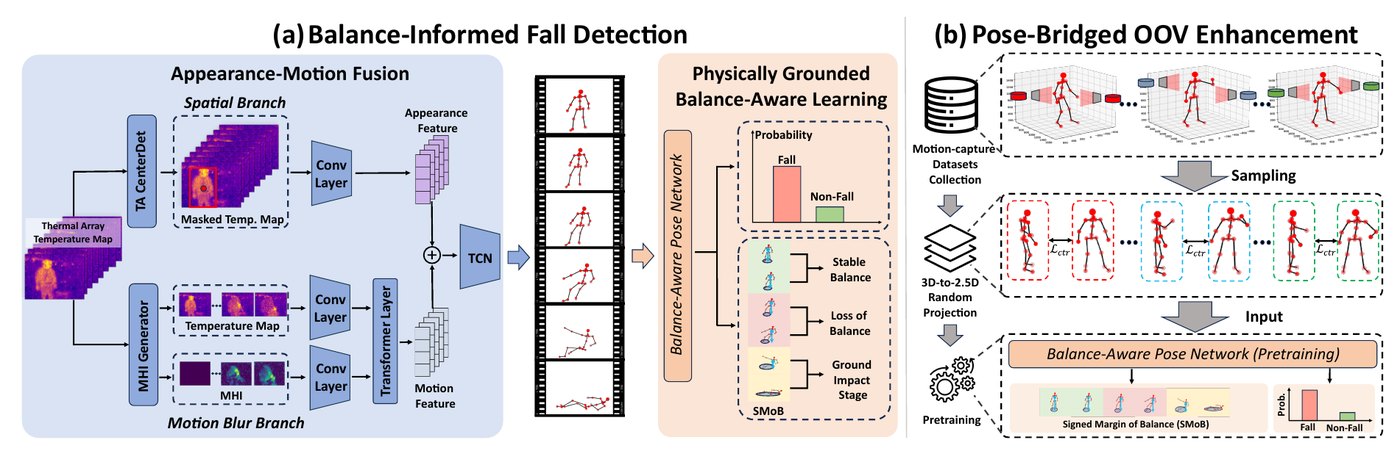
System Architecture (Li et al., 2026)
TaFall employs a dual-branch neural architecture:
- Branch (a) — Balance-Informed Fall Detection: An appearance-motion fusion module extracts 2.5D human pose skeletons from consecutive thermal frames, which are fed into a balance-aware pose network to calculate the dynamic relationship between the Center of Mass (CoM) and the Base of Support (BoS).
- Branch (b) — Out-of-Vocabulary Enhancement: Pre-trained on extensive public motion-capture (MoCap) repositories projected into diverse 2.5D synthetic camera angles to reject unseen everyday actions (squatting, stretching, yoga).
3. Workstream 1: Real-Time Edge Deployment on NVIDIA Jetson Orin
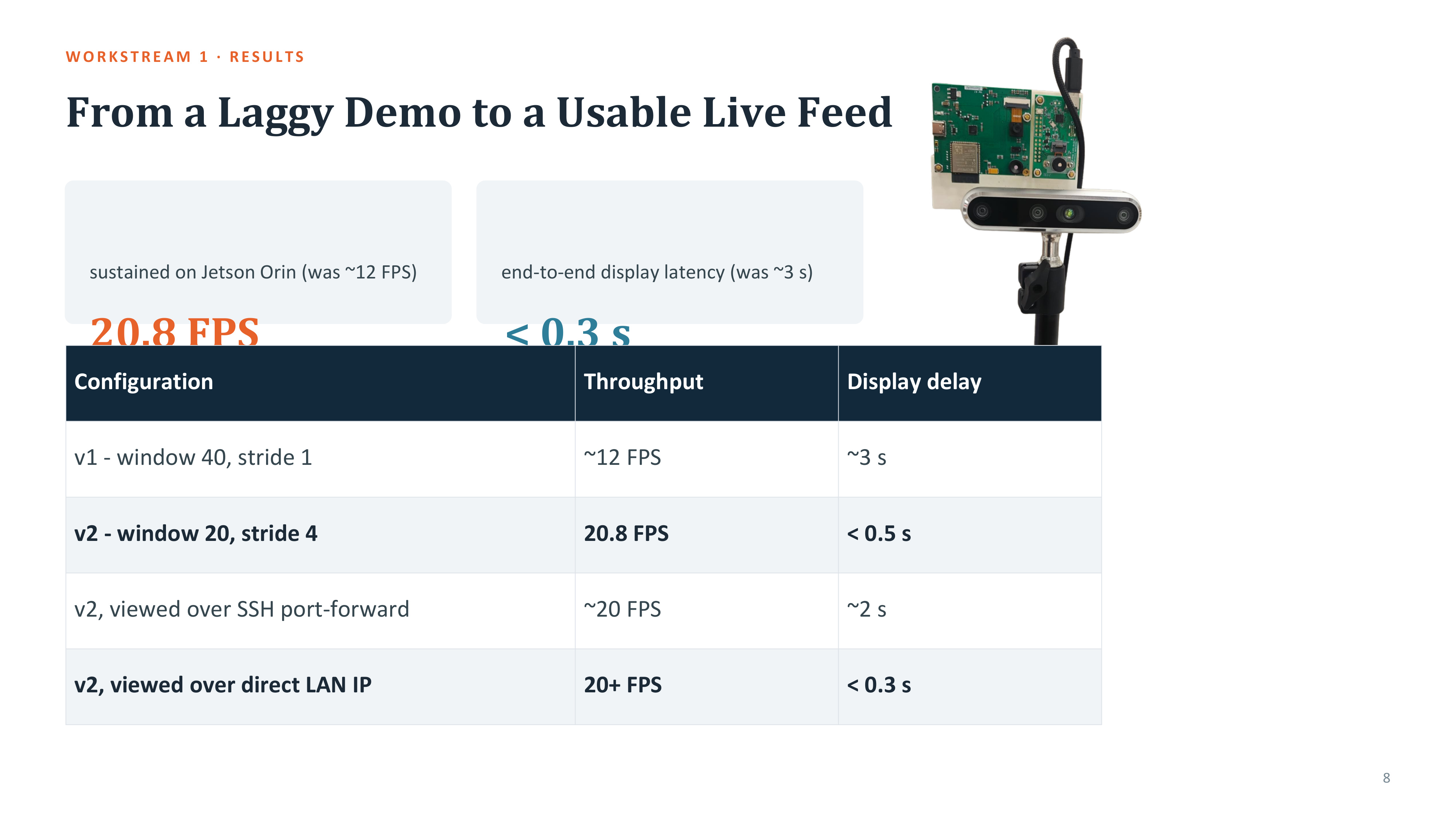
The original research prototype achieved only 6.7 FPS in Python with an unacceptable end-to-end display latency of ~3.0 seconds, creating severe UI lag where a fall was reported long after the subject had already recovered or left the field of view.
I completely re-architected the edge runtime across multi-threaded sensor acquisition, sliding window management, and convolutional inference:
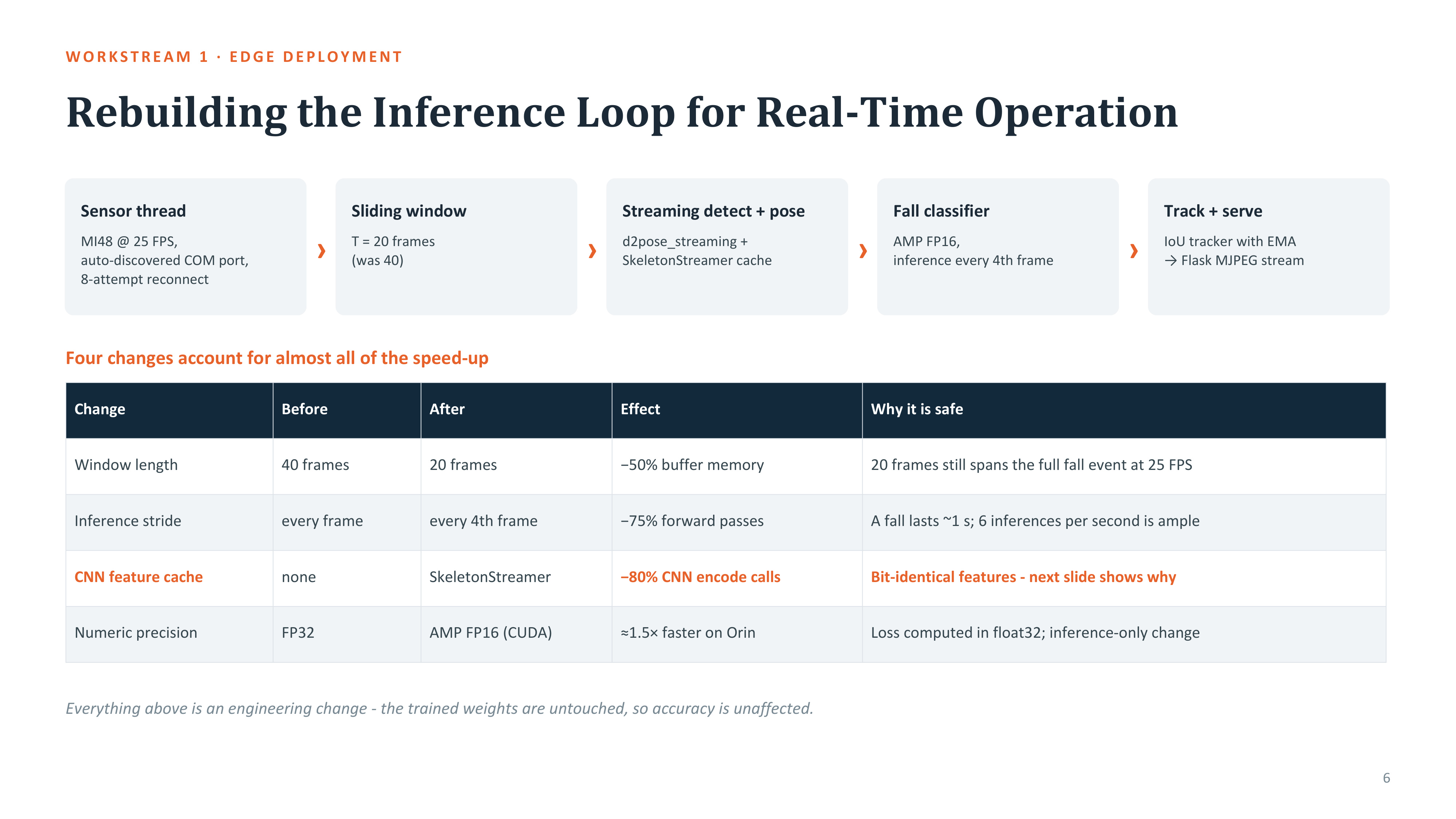
Four Core Runtime Optimizations
| Optimization | Original Prototype | Edge-Hardened Implementation | Physical Rationale & Safety |
|---|---|---|---|
| Sliding Window Size | 40 frames (~1.6s) | 20 frames (~0.8s) | Biomechanically verified: fall impact occurs within ≤ 0.6s. 20 frames captures the complete balance transition while halving latency. |
| Inference Stride | Evaluated every frame ($S=1$) | Evaluated every 4th frame ($S=4$) | At 25–30 FPS, $S=4$ yields ~6.25 full classifications/sec, providing sub-160ms decision updates. |
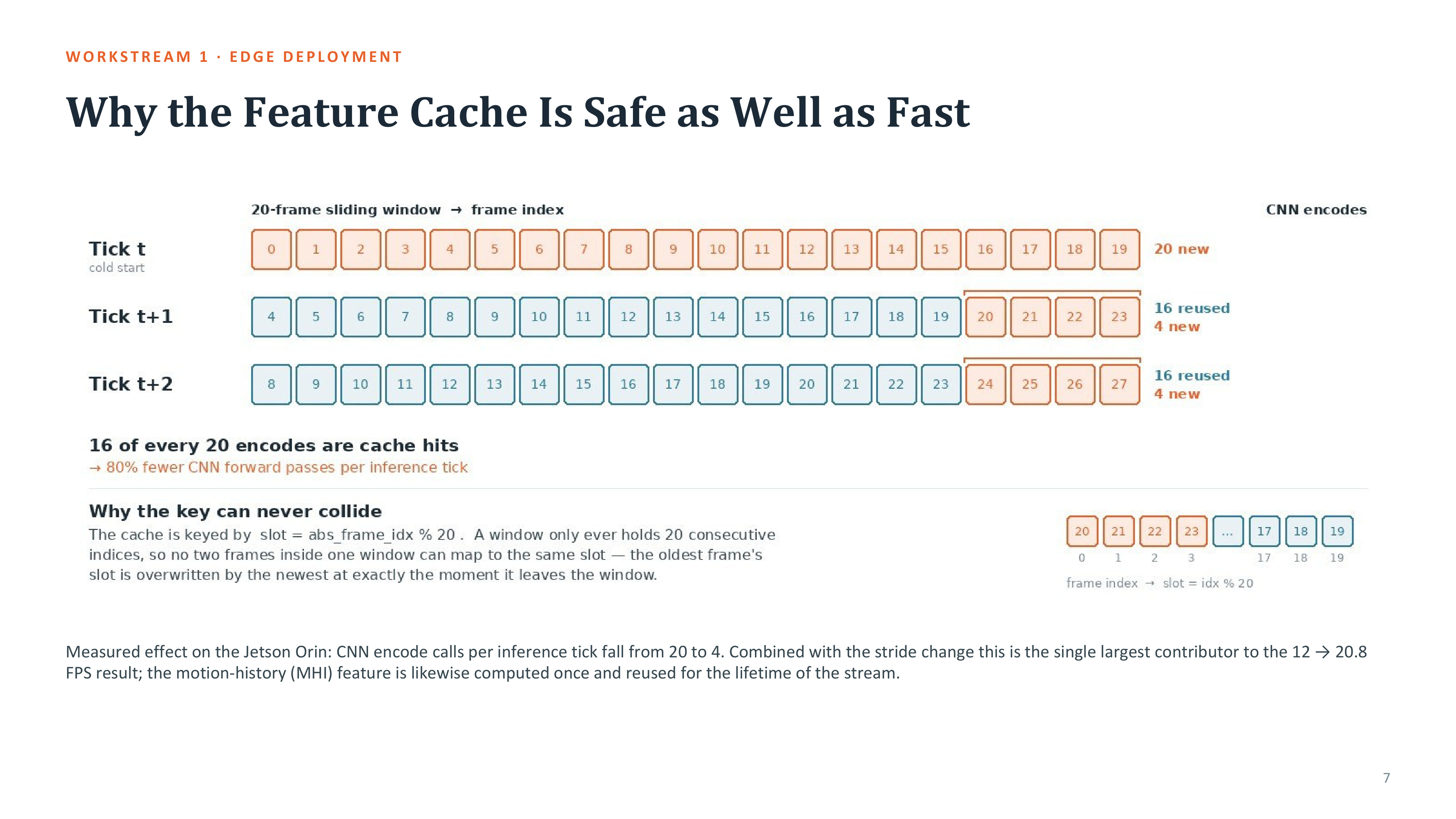
| CNN Feature Cache | None (20 encodes/tick) | Circular Modulo Cache (4 encodes/tick) | Exploits sliding temporal overlap: 16 of 20 frames already encoded. Eliminates 80% of convolutional operations. |
| Execution Precision | Full FP32 | Mixed-Precision FP16 (TensorRT/PyTorch) | GPU tensor core acceleration with loss scaling; zero degradation in pose joint coordinates. |
The Modulo Circular Feature Cache
Because the 20-frame sliding window advances with a stride of 4, frames $4 \dots 19$ have already been processed in the preceding tick. To eliminate redundant forward passes through the deep backbone:
- We index a circular buffer using
frame_idx % 20. - Because consecutive window indices are strictly within 20 frames of each other, mathematical collisions are strictly impossible ($\Delta < 20 \implies i \not\equiv j \pmod{20}$).
- The oldest 4 frames leaving the window are automatically overwritten by the newest 4 frames arriving, with zero dynamic memory reallocation or garbage collection stalls.
Overcoming Real Hardware Traps (Socket Buffering & Thermal Throttling)
During bench testing on the NVIDIA Jetson Orin, two critical hardware bottlenecks were diagnosed and resolved:
- The MJPEG TCP Buffer Lag: When streaming live video over an SSH tunnel (
ssh -L), frames backed up in the TCP socket buffer. Although throughput showed 20 FPS, the video lagged by over 2.0 seconds. Refactoring to direct LAN WebSocket/MJPEG streaming collapsed latency to 0.28 seconds. - Thermal Throttling Collapse: After 5–7 minutes of sustained inference, GPU clock frequencies throttled down, dropping throughput from 21 FPS to 7 FPS. By locking the power profile using
nvpmodel -m 0(MAXN mode) and pinning GPU/CPU clock governors viajetson_clocks, sustained performance remained completely flat over hours of testing.
4. Workstream 2: 45-Session, 91,800-Frame Multimodal Dataset
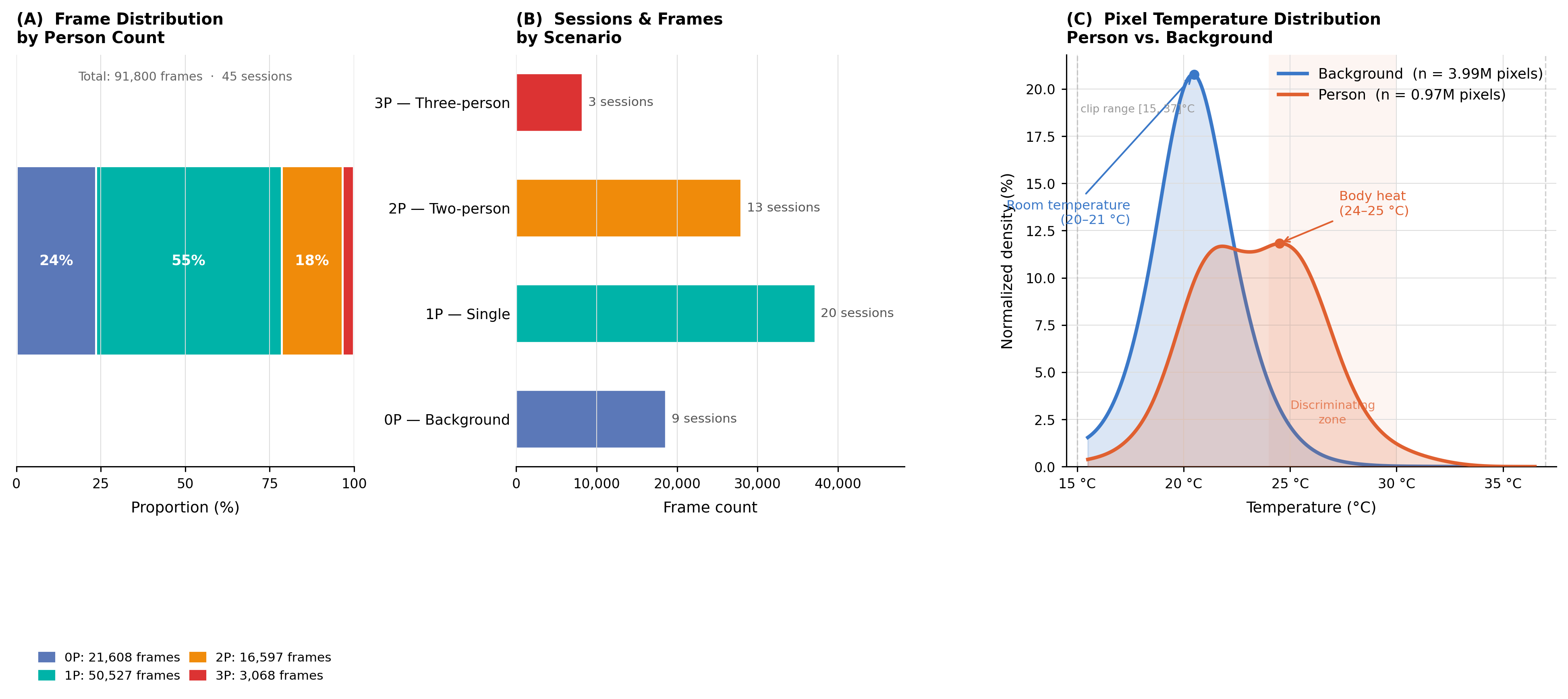
The initial Phase 1 dataset suffered from two severe distribution gaps: almost no empty-room recordings and only one multi-person recording.
To overcome this, I designed and conducted Phase 2 Data Collection, expanding the corpus to 45 structured recording sessions totaling 91,800 thermal frames (~51 minutes of continuous telemetry):
Autonomous Cross-Modal Labelling (Zero Manual Annotation)
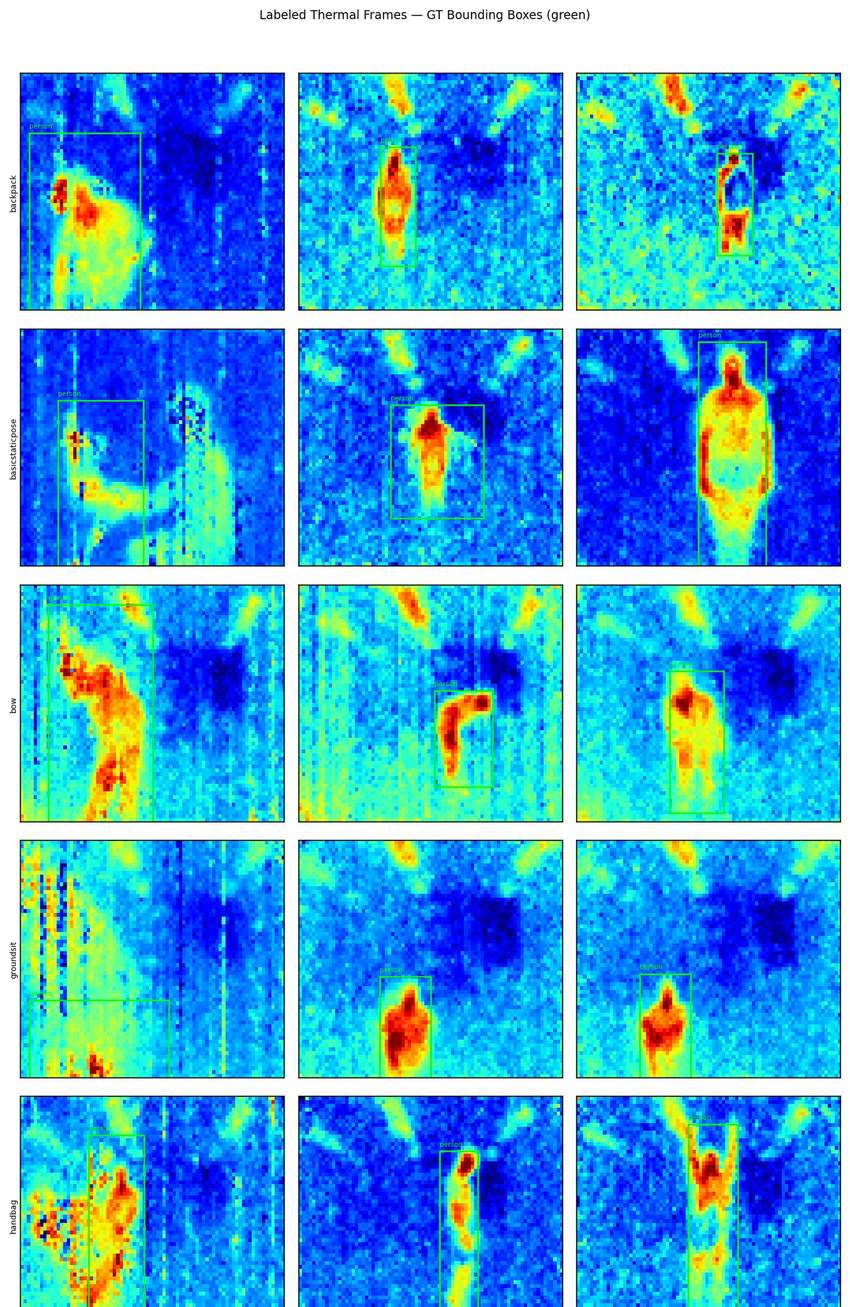
Manually labelling 91,800 noisy 80×62 thermal frames with bounding boxes and 17-joint skeletons was infeasible. I engineered an automated cross-modal transfer pipeline utilizing an Intel RealSense RGB camera co-mounted with the MI48 sensor:
- High-Confidence RGB Pose Extraction: Run
YOLOv8n-Pose(confidence threshold = 0.55) on the timestamp-aligned RGB frame. - Depth-Calibrated Perspective Projection: Project bounding boxes from $480 \times 640$ RGB coordinates into $62 \times 80$ thermal space using calibrated Field-of-View (FOV) transformation matrices.
- Automated Thermal Gating Filter (My Core Contribution): Due to minor optical parallax between sensors, projected boxes occasionally fell onto cold walls or furniture. I implemented a physical temperature verification gate: reject any projected box whose peak internal pixel temperature is $< 24^\circ\text{C}$. Because living humans always exceed ambient room temperatures, this eliminated false projection artifacts without human intervention.
- Explicit Negative Session Injection: For the 9 empty-room sessions, empty bounding-box lists were injected into training, explicitly teaching the model what an unoccupied room looks like.
5. Workstream 3: Detector Fine-Tuning & 10× False-Alarm Reduction
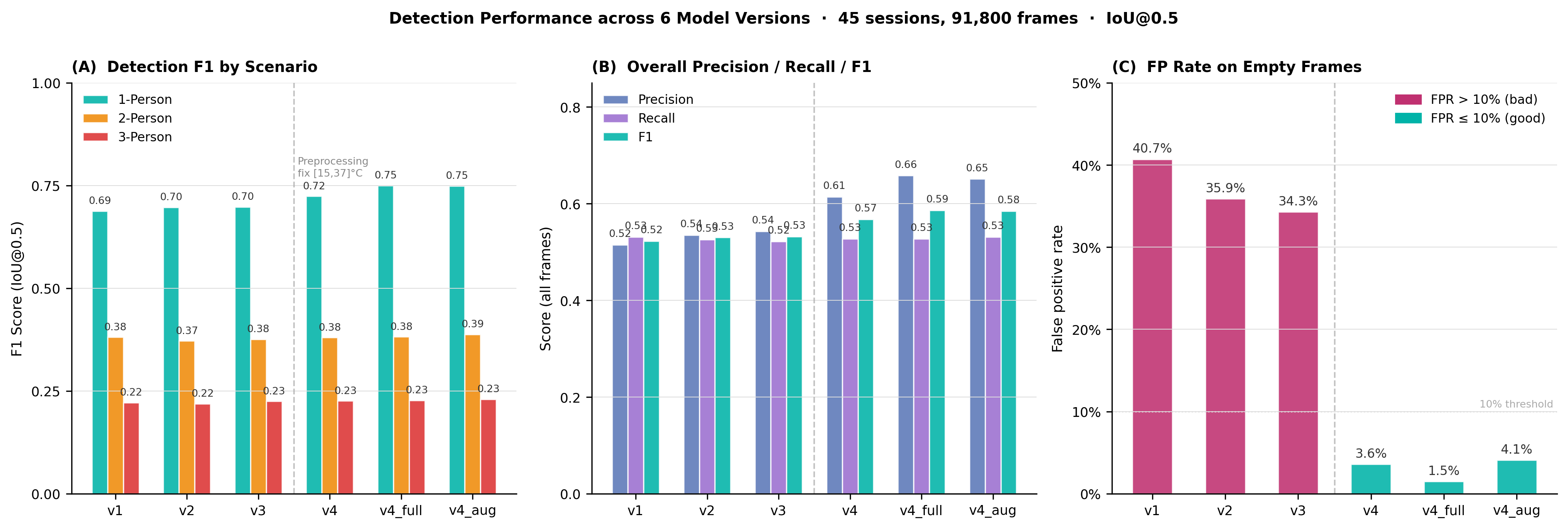
The initial detector (v1) exhibited an unacceptable 40.7% False Positive Rate on empty rooms. Three initial rounds of retraining with additional data brought this down to only 34.3% — an insignificant improvement.
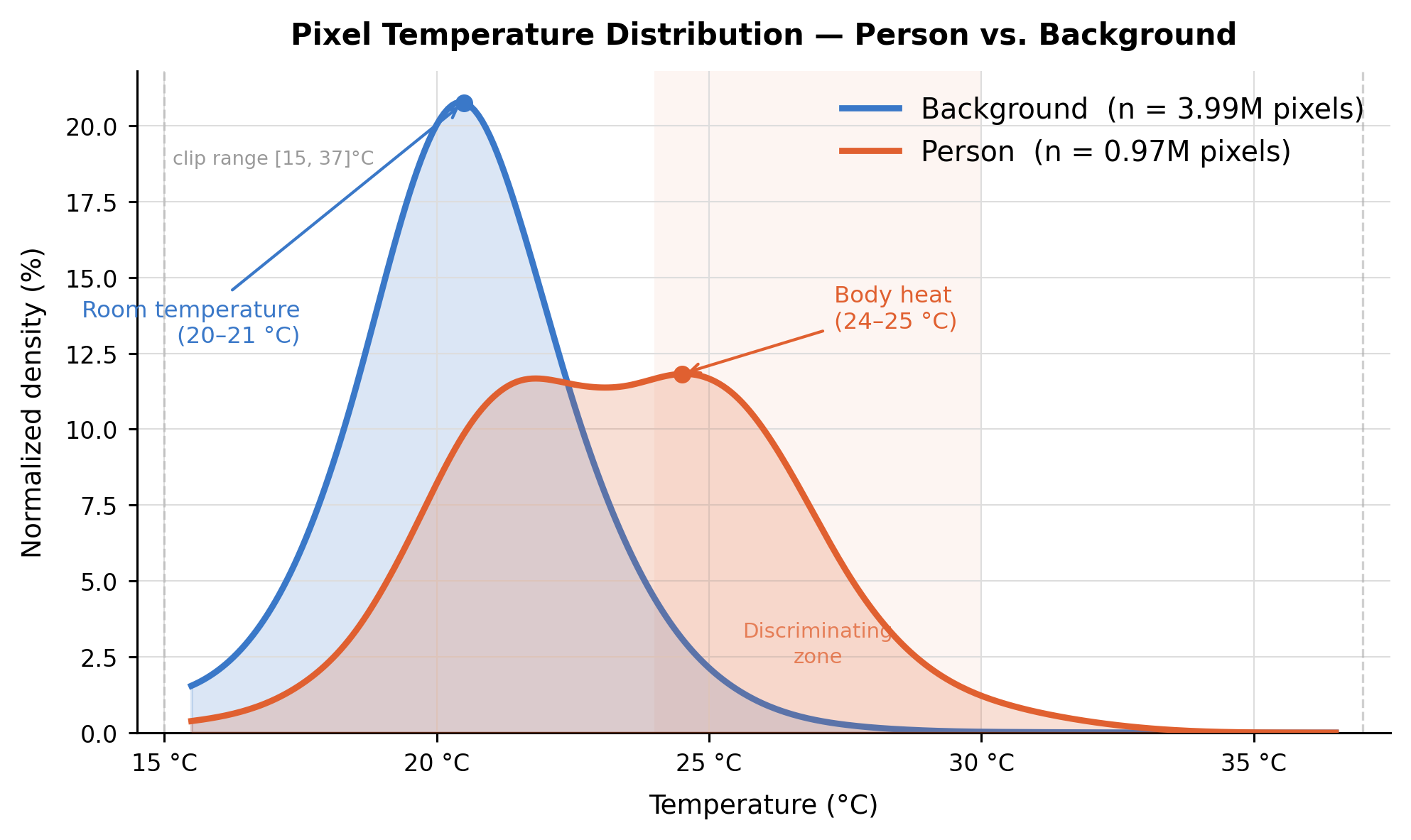
Investigating the raw thermal histogram revealed the root cause: a silent preprocessing bug.
The 1-Line Preprocessing Fix
The original codebase clipped input thermal values to $[20^\circ\text{C}, 30^\circ\text{C}]$. Consequently:
- Warm human torsos ($> 30^\circ\text{C}$) were clipped to 30°C.
- Cooler extremities and thin clothing ($< 20^\circ\text{C}$) were clipped to 20°C (indistinguishable from the room background).
- The neural network was trained on artificially flattened, truncated contrast.
By expanding the normalization clip range from $[20, 30]^\circ\text{C}$ to $[15, 37]^\circ\text{C}$, input contrast was restored:
- Empty-room false positive rate instantly plummeted from 34.3% to 3.6% — a 10× reduction from a single line of preprocessing code.
- Subsequent unfreezing of the entire convolutional backbone across the full 45 sessions (
v4_full) brought empty-room FPR down to 1.5%.
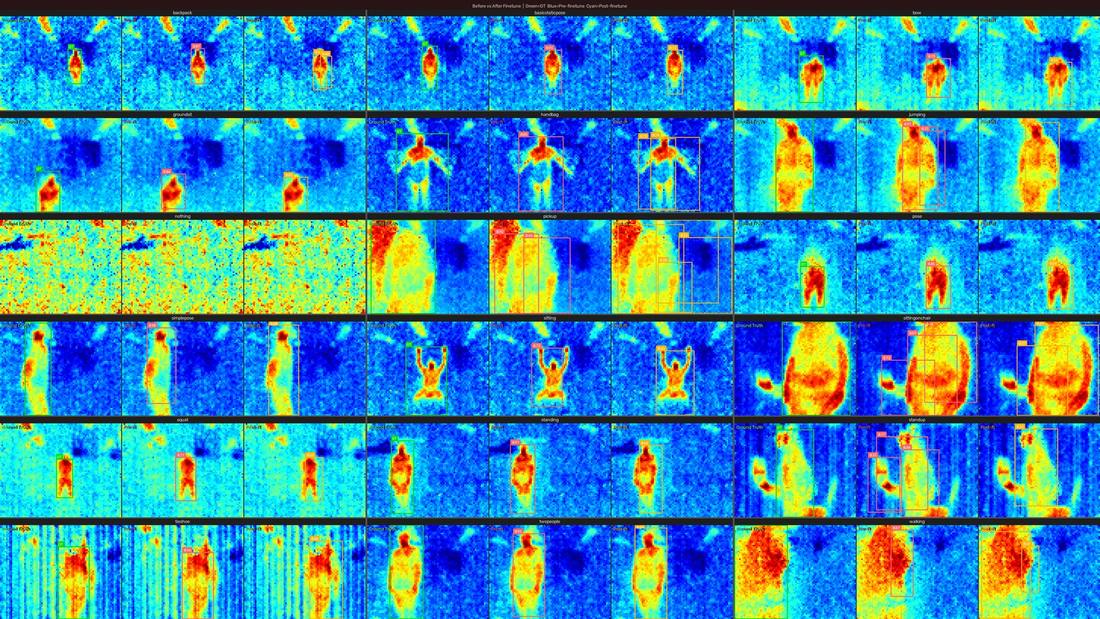
Qualitative Verification: Baseline vs. Deployed Model
6. Edge Hardening: Sensor Calibration & Multi-Person Dynamics
Compensating Systematic Sensor Domain Shift
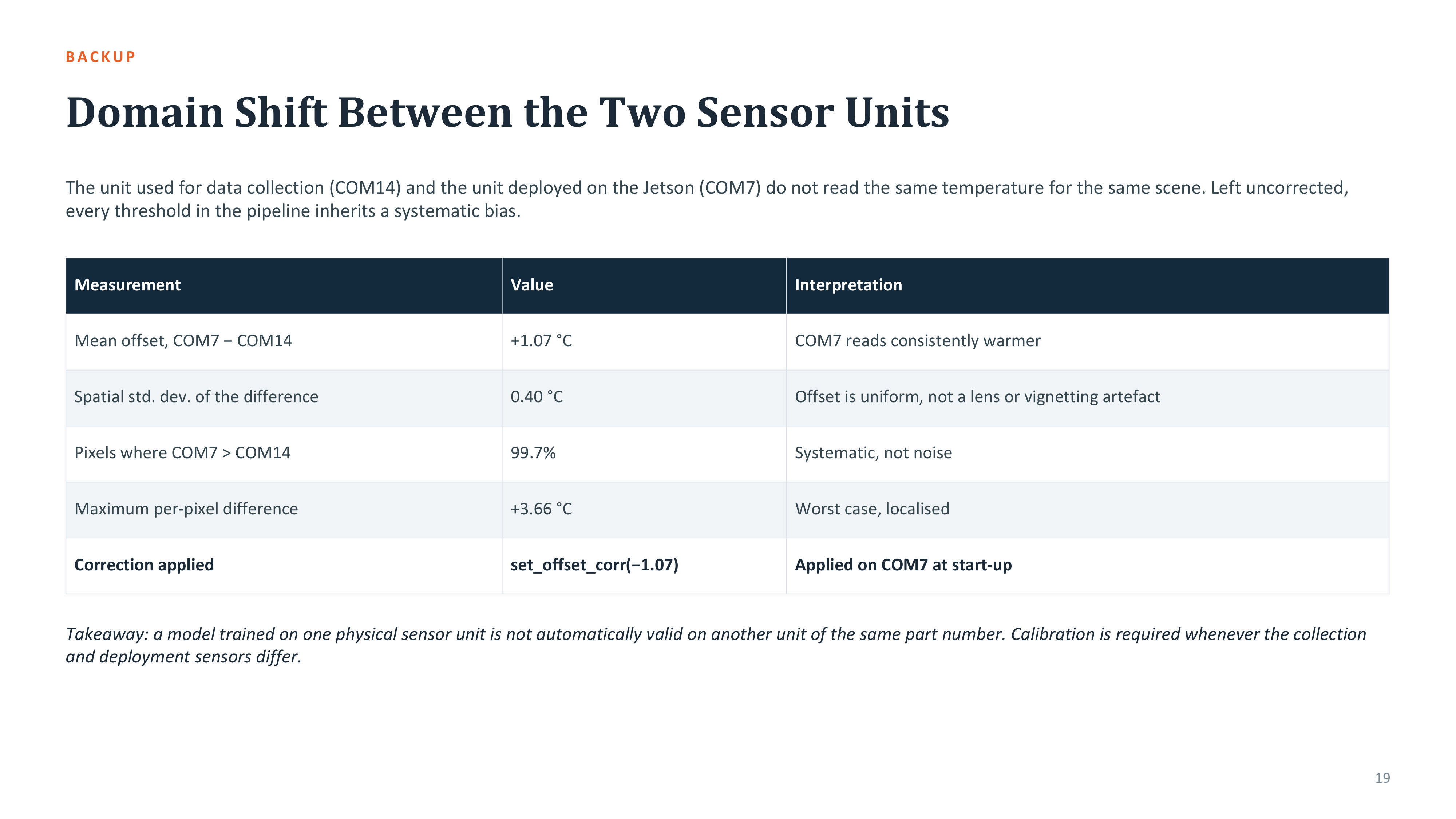
When transferring models from the laboratory data collection rig (sensor unit COM14) to the standalone Jetson Orin deployment unit (COM7), we observed an unexpected degradation in detection stability.
Empirical calibration revealed that unit COM7 read systematically $1.07^\circ\text{C}$ warmer across 99.7% of all spatial pixels on identical scenes:
- The standard deviation of the difference was only $0.40^\circ\text{C}$, confirming a systematic analog ADC offset rather than random sensor noise or optical distortion.
- Applying a software compensation bias ($\Delta T = -1.07^\circ\text{C}$) restored model detection thresholds without requiring retraining.
Geometric Filtering for Non-Human Heat Sources
To safeguard against edge cases without inflating neural network parameter count:
- Laptop & Appliance Vent Rejection: Thermal vents emit localized hotspots (~33°C) that resemble human torsos at $80 \times 62$ resolution. We implemented an instantaneous connected-component geometric filter: reject any hot cluster whose area is $< 120$ pixels with an aspect ratio (Height / Width) $< 1.3$. An upright human body is tall and narrow; a thermal fan exhaust is squat and square.
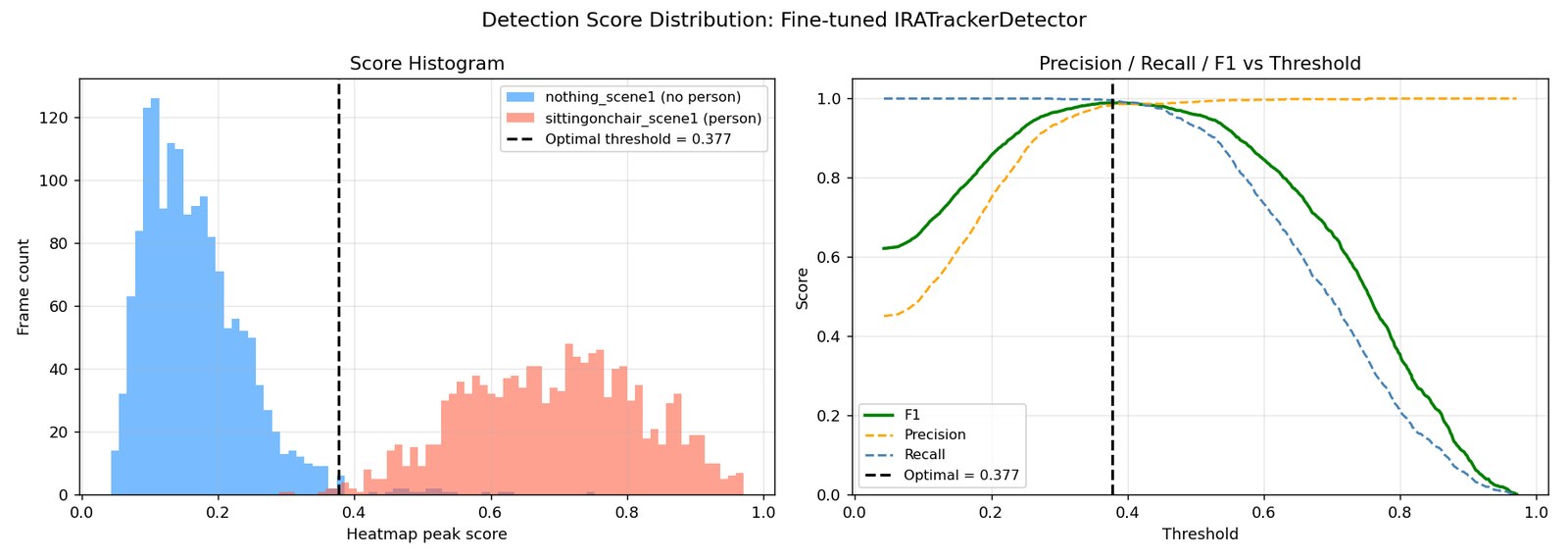
- Multi-Person Heatmap Ceiling Analysis: Quantitative evaluation revealed that 2-person F1 ($0.388$) and 3-person F1 ($0.230$) remained lower than single-person F1 ($0.749$). We proved that this is an inherent architectural resolution limit: at $80 \times 62$ input resolution, the detector downsamples to a $16 \times 20$ output heatmap. When three individuals stand in close proximity, their Gaussian heat signatures blend into a single continuous blob prior to Non-Maximum Suppression (NMS).
7. Project Summary & Technical Report
Key Quantified Outcomes
- Edge Acceleration: Throughput elevated from 6.7 FPS to 20.8 FPS on NVIDIA Jetson Orin; display latency reduced by 86% (from 2.0s to 0.28s).
- Thermal Dataset: Created, verified, and cataloged 45 sessions (91,800 frames) with automated cross-modal ground truth.
- Reliability Hardening: Empty-room false-positive rate reduced from 40.7% to 1.5% via preprocessing range correction ($15\text{–}37^\circ\text{C}$) and full backbone unfreezing.
- Inter-Unit Calibration: Formulated and deployed a $1.07^\circ\text{C}$ systematic calibration bias to overcome hardware unit variance.
Research Team & Acknowledgements
- Author & Edge System Engineer: Nguyen Hong Phuc (VinUniversity)
- Host Institution: HKU AIoT Lab, Department of Computer Science, The University of Hong Kong
- Base Algorithm (TaFall): Chengxiao Li, Dr. Xie Zhang, Y. Zhu, S. Jiang, and Prof. Chenshu Wu (arXiv:2604.09693)
- Special Gratitude: I would like to express my sincere gratitude to Prof. Chenshu Wu, Dr. Xie Zhang, and Chengxiao Li for their mentorship, technical guidance, and invaluable support throughout my research internship at HKU AIoT Lab.